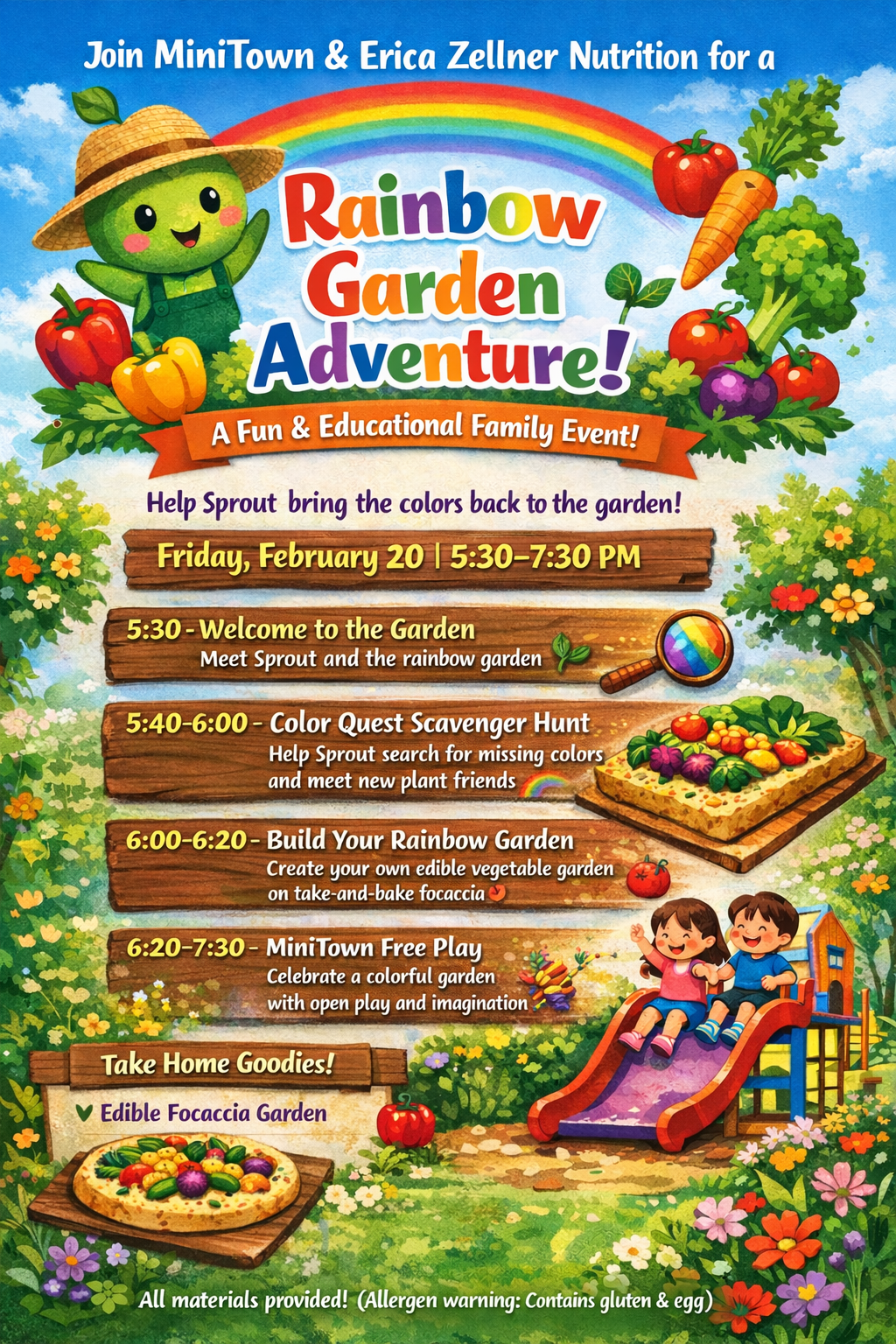
Rainbow Garden Adventure: How Play, Food, and Science Come Together to Support Healthy Eating in Kids
Helping young children develop healthy eating habits can feel overwhelming for many caregivers. Picky eating, food refusal, and strong preferences for certain colors or textures are extremely common in early childhood — and, scientifically speaking, completely normal.
That’s exactly where experiences like the Rainbow Garden Adventure Kids Nutrition Workshop come in.
This workshop was designed as a hands-on, play-based learning experience where children and their caregivers explore food together through storytelling, sensory activities, and imaginative play — guided by pediatric nutrition principles and led by Erica Zellner, a Certified Nutrition Specialist and Licensed Dietician Nutritionist specializing in pregnancy, postpartum, and child nutrition.
Why food exploration works (the science behind it)
Research in pediatric nutrition and developmental psychology consistently shows that early exposure and repeated, pressure-free interactions with food are key factors in improving children’s eating habits.
Here’s why this type of activity is so effective:
1. Exposure without pressure builds acceptance
Studies show that children may need 10–15 neutral exposures to a new food before accepting it. Neutral exposure means:
Seeing the food
Touching it
Smelling it
Talking about it
— without being forced to eat it.
In the Rainbow Garden Adventure, children meet vegetables as characters in a story, interact with them in a playful way, and taste them at their own pace. This lowers anxiety and builds familiarity — a critical step toward acceptance.
2. Sensory play supports brain development and food curiosity
Young children learn through their senses. Activities that involve:
Color
Texture
Smell
Hands-on building
stimulate multiple areas of the brain at once. Research shows that sensory-based food play helps children become more open to trying new foods, especially those who are hesitant or selective eaters.
Building an edible garden on focaccia allows kids to explore vegetables in a non-threatening way — food becomes something to create, not something to battle over.
3. Storytelling increases engagement and memory
From a cognitive development standpoint, storytelling helps children:
Retain information
Create emotional connections
Understand abstract concepts (like “nutrition”) in a concrete way
By following Sprout’s journey to restore color to the garden, kids associate vegetables with positive emotions, curiosity, and fun — not pressure or rules.
Why this matters for caregivers too
This workshop isn’t just beneficial for children — it’s incredibly valuable for caregivers.
Caregivers observe:
How food can be introduced without pressure
Language that supports healthy eating (“exploring” instead of “you have to eat this”)
How play-based approaches reduce resistance
Scientifically, caregivers play a critical role in shaping children’s long-term relationship with food. When adults model curiosity, calmness, and neutrality around eating, children are more likely to develop self-regulation and a positive relationship with food.
This type of guided experience gives caregivers practical tools they can take home, helping them feel more confident when offering new or unfamiliar foods.
Led by a trusted expert
The Rainbow Garden Adventure is guided by Erica Zellner, a Certified Nutrition Specialist and Licensed Dietician Nutritionist with extensive experience in:
Pregnancy nutrition
Postpartum nutrition
Infant and child nutrition
Her approach is grounded in evidence-based science while remaining realistic, compassionate, and family-centered — focusing on progress, not perfection.
A meaningful learning experience through play
At its core, this workshop reflects what we value most at MiniTown:
Learning through play
Supporting caregivers
Creating experiences that nurture both development and connection
It’s not about “fixing” picky eating.
It’s about building curiosity, confidence, and positive food experiences — early, gently, and joyfully.
Interested in joining?
Our first Rainbow Garden Adventure Kids Nutrition Workshop will take place on
February 20th, from 5:30–7:30 PM, and is designed for children ages 2–6.
$45 for the first child
$38 for siblings
Spots are very limited to keep the experience intimate and meaningful
For families who are interested, we recommend booking early.